Tuesday, July 14, 2009

Solar Hot Water - revisited

I found this link the other day
http://builditsolar.com/Projects/PoolHeating/DIY/SimplePoolHeat.htm
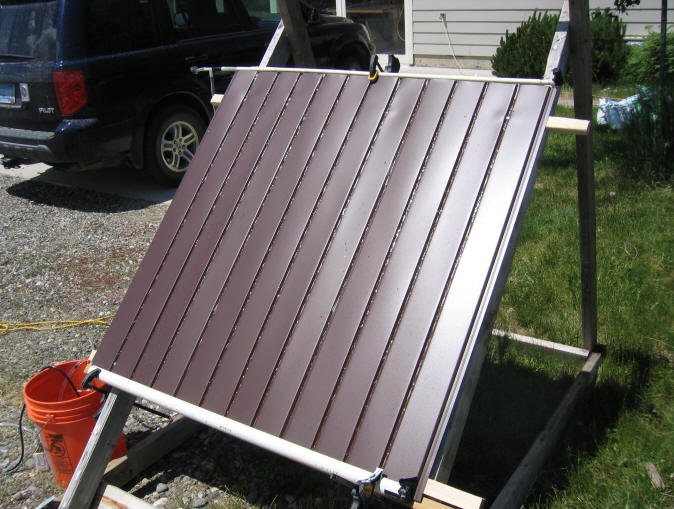
Remember the other day when I talked about using the roof for a solar heater, but doing it with no glazing? Well this article show testing on a small scale. He has small channels for the water to flow through, but it is exposed to the air. He tried to simulate more channels by using the space between the channels and allowing water to flow there. The efficiency went up.

The more surface area the water flows across, the more efficient it becomes. But you also get more evaporation. At 2,200 btu/square foot day, you can get a lot of power. Most collectors are maybe 20 square feet and that means 44,000 btus per day put into the water. So, a 50 gallon tank with about 400 pounds of 60 F water could be raised to 110 F in about half a day. But using 1,000 square feet of roof would raise it to the same temp in about 5 to 10 minutes. My God! And it will do it at a higher efficiency than a evacuated tube would. We are talking 2.2 million BTUs per day possible.

You would probably want a small solar panel to drive two or three cheap pumps in series. That way you would have enough head pressure to get to the roof without having to buy a VERY expensive pump to do it. You don't need much flow, just enough pressure to get it to the roof. With a big insulated 150 - 300 gallon tank acting as your heat exchanger, you would only need to run the system for about 1 or 2 hours every other day. So evaporation won't be that bad. Since you are using the gutters to collect the hot water, you could also make up some water losses via rain collection. A simple diverter on the down spout can give you full control.

But rember, this type of solar collector is more efficient if the ambient air and water temperature are fairly close, like within 50 to 70 degrees different or less. So, if you wanted 140 F water and the air temperature is 70 - 90 F then you are ok. But if it were 50 F outside, then getting the water temperature above 100 - 120 F would be very hard.

I'm just blown away by how much potential energy is available on the average roof. And you don't need a lot of money to throw at the problem. And I know evaporation is an issue, but if you run the system for 1 to 2 hours a day on the sunny days, then you might lose 2 gallons a day or so. That evaporates into the environment and someday soon it will rain and you will collect it back. So it can be sustainable. Even the pump energy would be from the sun.

Also, a good source of small, sometimes free pumps can be dishwashers. They aren't meant to run all day, but they can easily run for 1 to 2 hours and they can pump hot water at 140 F as well.

Richard

Monday, July 13, 2009

Friday, July 10, 2009

Air Powered Motorcycle


If you guys remember this other post http://poormanguides.blogspot.com/2009/07/weed-eater-air-steam-engine.html from July 1st, then this would be the next logical progression. This is a picture of a motorcycle powered by air. It was designed by Edwin Yi Yuan and supposedly it is fast, efficient and has a long range. I'll have to see the numbers though.

But still, nice idea. If you were to use carbon fiber tanks and pressurize to 5,000 or even 10,000 psi then the range should be pretty good.

Take a look at this picture from Howstuffworks.com
You could take the reed valve out and then plug the exhaust port. Then have a spring loaded valve at the top instead of the spark plug. The top of the piston would have a welded tab that hits the valve and opens it. This lets air in and pushes the piston down. The length of the welded tab is such that when the top of the piston is almost to the air intake port, then the spring loaded valve shuts. This gives a longer push of the piston without wasting compressed air through the exhaust port. Effectively, it moves the exhaust port lower so the power portion of the stroke is longer.

Richard

Thursday, July 9, 2009

How to Find a FREE Deep Cycle Battery

How to Find a FREE Deep Cycle Battery: "I hope this helps someone find a free or at least a cheap deep cycle battery."

Electric Bike Anyone?

Here is an electric bike from Currie Technologies called Ezip on sale for $299 at ToysRus.com.

It looks like it has a 10-15 mile range. It is 450 watts and goes up to 18 mph.

Of course, you could take this motor shown above and replace your existing motor for double the power to 900 watts instead of 450 watts. This would half the range, but you could add a second battery pack.

Or you could make your own from scratch. Check this video out.


Richard

Wednesday, July 8, 2009

Solar Food Dehydrator

This is a picture I found on http://www.jrwhipple.com/sr/soldehydrate.html
It is pretty self explanatory. I would just add that the food needs to be on a screen type tray that is elevated enough so the warm air can get through. And also, the food should not be exposed to the sun so a piece of cardboard sticking up in front of the top screen would stop the sun from getting to the food through the screen.

If you want something more permanent then take a look at this one.
This can be found here http://www.geopathfinder.com/9473.html?*session*id*key*=*session*id*val*
It is much more permanent, you could even leave it outdoors all year. But, it is also much more expensive and complicated to make. I may try the cardboard one first to see how it works.

Richard

Tuesday, July 7, 2009

Homemade Spot Welder


Here is a homemade spot welder I made. It just connects to a car battery and welds thin steel and tin pretty well. The far right side is where the welding occurs. Just hook one side of the battery to the left side on the longer copper pipe. And hook the other side of the battery to the shorter pipe where there is a gap in the electrical tape. If you make this one, make the pipes shorter, about half the length. There is too much play in mine and that is one thing that I would change.

Take a look at this video. It talks about resistance spot welding and how it works.
http://www.youtube.com/watch?v=AwL1CAg43PU&NR=1

Here are some videos of people using microwave transformers to make spot welders.

http://www.youtube.com/watch?v=Wp7JF2sANsw
http://www.youtube.com/watch?v=PpME0fvmeg8&feature=related
http://www.youtube.com/watch?v=9spgDiU3_nw&NR=1

Just be careful when working on microwave ovens. The main thing is make sure it is unplugged and then short the capacitor out using a screwdriver. Those capacitors are very dangerous.

Richard